
Condition Assessment
Start With the Cause, Not the Crack
A crack is a symptom. It may reflect shrinkage, normal movement, settlement, overloaded edges, poor drainage, a weak base, impact, or geometry around a corner or penetration. Filling the crack changes the surface, but it does not automatically stop movement underneath it.
Look at the pattern. One isolated stable crack is different from several slabs that have dropped, a driveway with repeated patches, a patio that drains toward the house, or concrete whose edges are breaking because the base no longer supports them.
When Repair Can Make Sense
Repair is more attractive when damage is isolated, the surrounding slab remains sound, elevations are still useful, and there is no strong evidence of continuing settlement or a widespread base problem. Localized edge repair, crack treatment, surface repair, or replacing a single panel can sometimes restore function without rebuilding the entire area.
Cosmetic expectations matter. Repair materials rarely disappear completely into older weathered concrete. If appearance is the main goal across a highly visible surface, a structurally adequate patch can still look different from the surrounding slab.
When Replacement Becomes the Better Scope
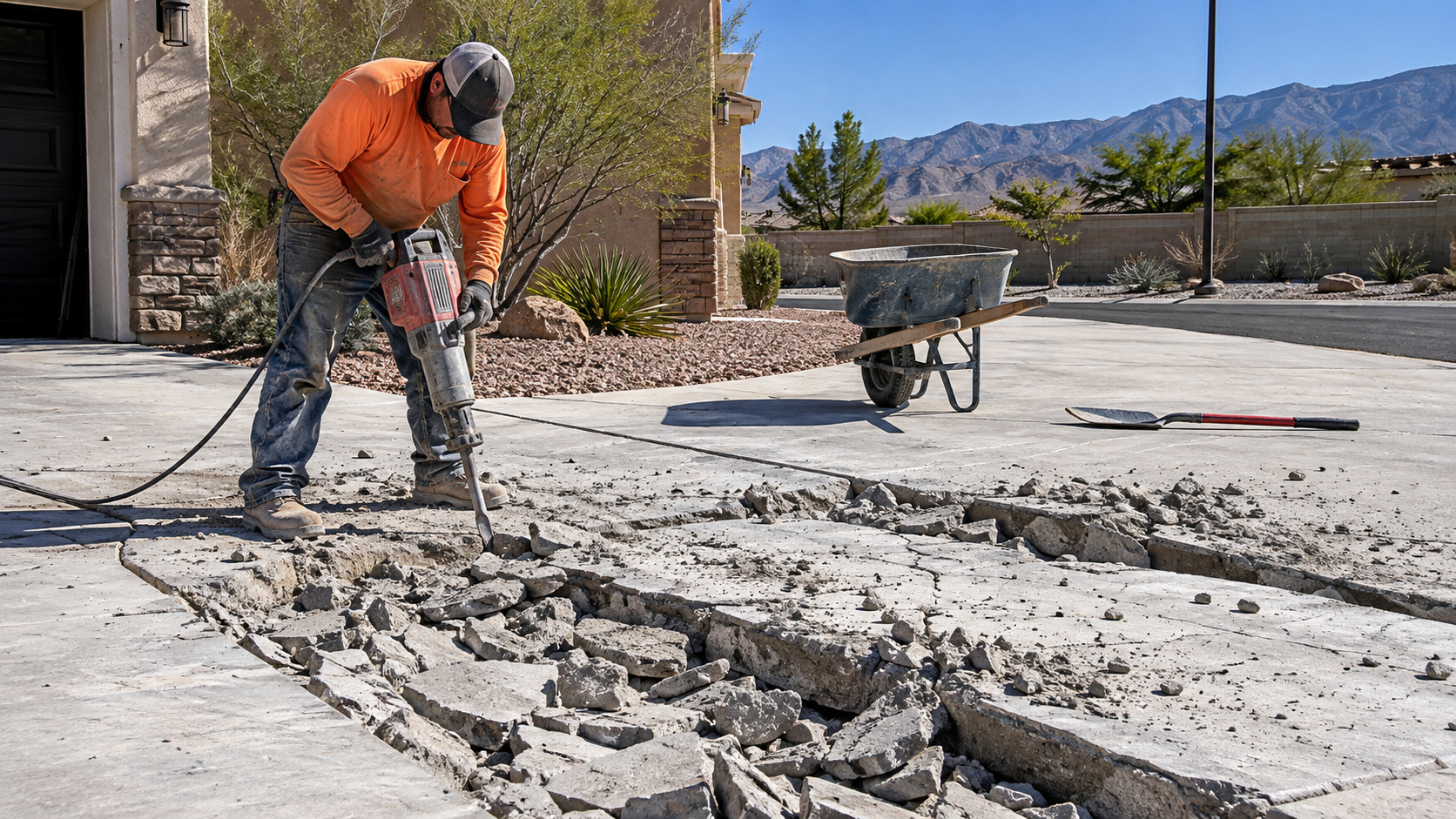
Replacement is more compelling when damage is widespread, several panels have moved, water collects because grades are wrong, the slab no longer serves the property, or the base needs to be corrected. Removing concrete creates access to rebuild the support below it and reset elevations.
Replacement can also be a design opportunity. A narrow old driveway can be widened, a failed patio can be regraded, or broken walkways can be reorganized into a more useful circulation path instead of reproducing the old layout exactly.
Localized damage, stable surroundings, useful elevations, and a realistic cosmetic expectation.
Widespread failure, settlement, poor drainage, repeated patches, or an obsolete layout.
Cracks that continue moving, unexplained settlement, structural concerns, or damage tied to another system.
Cost Comparison Is About Life of the Fix
A small repair has a lower initial price than demolition and replacement. That does not mean it is cheaper if the repair fails repeatedly because the underlying problem remains. Conversely, replacing an entire surface for a minor stable defect can be unnecessary.
Ask for the scope to identify what is being corrected. If replacement is recommended, understand whether base, drainage, jointing, thickness, or layout is changing. If repair is recommended, understand what movement or appearance should still be expected.
North Las Vegas Conditions to Consider
Desert sun, large temperature swings at the surface, dry air, irrigation next to hardscape, landscaping changes, vehicle loads, and site-specific base conditions can all influence concrete over time. None of those factors proves the cause of a particular crack by itself.
The practical approach is to inspect the whole surface, adjacent drainage, joints, edges, and changes in elevation before choosing a repair method.
Do Not Diagnose From a Photo Alone
Photos are useful for the first conversation, but settlement, base failure, drainage, and structural questions may require an on-site evaluation.